

Routes to Professional Membership
Qualified Environmental Professionals are defined as professionals who possess advanced expertise in environmental sciences and management, a comprehensive understanding of the interdisciplinary nature of environmental challenges, and the practical skills necessary to protect, restore, and sustainably enhance the environment. They are also expected to uphold the highest standards of integrity, adhering to HKIQEP’s core values, Code of Ethics and Code of Conduct (https://hkiqep.org/codes-of-ethics-and-conduct/).
In addition to a strong foundation of environmental principles and practices, Qualified Environmental Professionals may specialise in more specific areas within the broader environmental field, such as air quality management, greenhouse gas mitigation, water resource management, waste management, energy efficiency, or other expert environmental disciplines.
HKIQEP offers three distinct routes to Professional Membership, each with its own pathway to meet the application requirements. Regardless of the route chosen, all applications are subject to rigorous assessment and review. Final approval by the General Council is required before HKIQEP Professional Membership is granted.
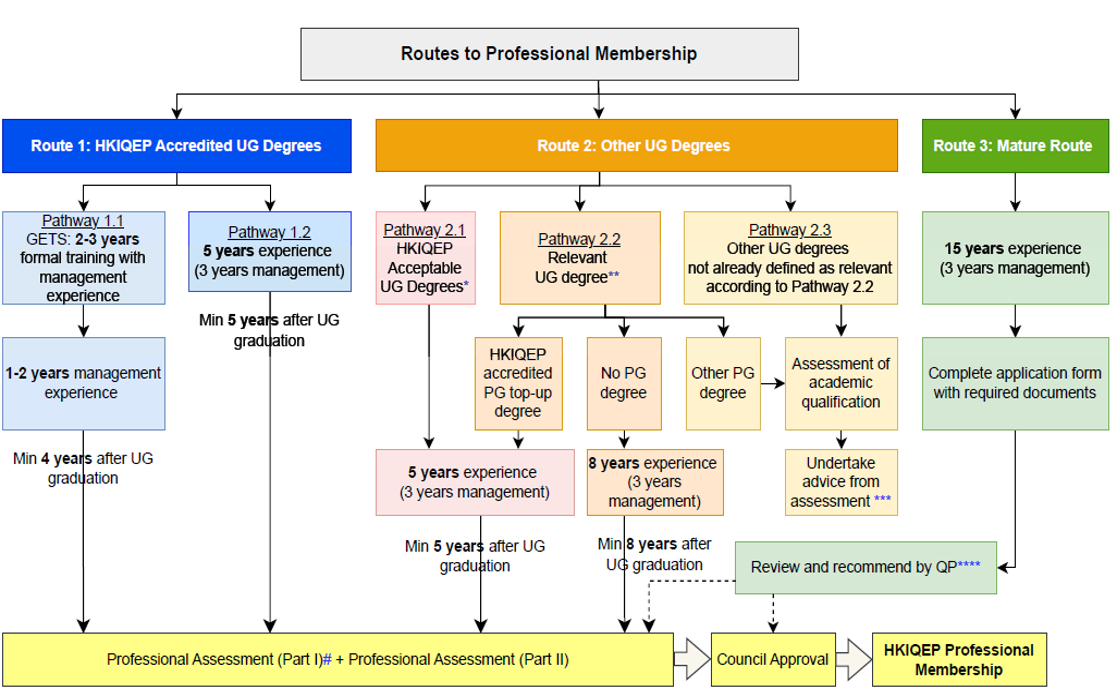
Details of the three routes and their respective pathways are summarised below and in the accompanying diagram. The number of years specified at each stage below and in the diagram refers to the minimum years of environmental-related experience. Proficiency will also be assessed through the review of submitted documents and/or an assessment interview.
Professional Assessment Overview:
The Professional Assessment consists of two parts (Part I and Part II):
- Part I can be taken at any time, and a passing result is valid for 5 years (60 months). For candidates applying through the mature route, Part I may be waived at the discretion of the HKIQEP Qualification Panel (QP).
- Part II should be taken within the 5-year validity period of Part I, AND after the candidates have accumulated the required years of environment-related experience for their chosen route.
Route 1: HKIQEP Accredited Undergraduate (UG) Degrees
For candidates holding HKIQEP-accredited undergraduate degrees, two pathways are available:
Pathway 1.1 Graduate Environmental Training Scheme (GETS):
Accumulate at least 4 years of environment-related experience under GETS, which includes 2–3 years of formal on-the-job training followed by 1–2 years of management experience. Candidates must also complete the Professional Assessment as outlined in the overview.
Pathway 1.2 General path:
Accumulate at least 5 years of environment-related experience, including 3 years in a management role. Candidates must also complete the Professional Assessment as outlined in the overview.
Route 2: Other UG Degrees
For candidates whose undergraduate degrees are not recognized by HKIQEP, three pathways are available:
Pathway 2.1 HKIQEP Acceptable UG Degrees*
The HKIQEP General Council recognizes all Bachelor of Science (BSc) and Bachelor of Engineering (BEng) degrees awarded by any UGC-funded university as acceptable environmental-related undergraduate qualifications. Students enrolled in these UG programmes before September 2025 remain eligible for the 5-year environment-related experience requirement (including 3 years management experience).
Pathway 2.2 Relevant UG degree** :
-
- i) Possess an HKIQEP accredited PG top-up degree AND accumulate 5 years of environment-related experience (including 3 years management experience), OR
- ii) Accumulate 8 years of environment-related experience (including 3 years management experience) without an HKIQEP accredited PG top-up degree.
Candidates for this pathway must also complete the Professional Assessment as outlined in the overview.
Pathway 2.3 Other UG degrees not already defined as relevant according to Pathway 2.2 : Undergo an assessment of their academic qualification and follow individualized advice based on the assessment***.
Route 3: Mature Route
Candidates with 15+ years of environment-related experience, including at least 3 years in a management role, may apply through the Mature Route by submitting an application form. The form requires candidates to provide the necessary information, relevant supporting documents, and a professional paper following the specified guidelines. The HKIQEP Qualification Panel (QP) will review the submission and recommend the next steps****, which may include taking the Professional Assessment (Part I and II), waiving Part I and proceeding directly to Part II, or, in exceptional cases, direct submission for HKIQEP General Council approval.
Remarks:
# Can be taken anytime but is valid for 60 months only.
* Included all BSc and BEng degrees awarded by UGC-funded universities before September 2025.
**For degrees to be considered relevant, their training is assessed to contain analytical methods, multi-disciplinary collaboration, problem-solving, effective communication, and lifelong learning. Examples include science, engineering, or business UG degrees awarded by UGC-funded universities in Hong Kong or mainland universities recognized under the ‘Double First-Class/Project 211/Project 985’ list by the Chinese Ministry of Education.
*** Advice from the assessment may include: (1) directly pursue an established path; or (2) complete additional courses or gain more work experience before pursuing an established path.
**** Recommendations from QP after review of the submitted paper may include: (1) complete the process starting with Professional Assessment (Part I); (2) waive Part I and allow the candidate to proceed directly to Part II; or (3) in exceptional case submit for approval by the HKIQEP General Council.
For information on the requirements and processes for different membership classes, visit: https://hkiqep.org/membership-class/
For information on the qualification process, visit: https://hkiqep.org/qualification-process-general/
Should you have any queries concerning HKIQEP membership, please contact us through membership@hkiqep.org
Last updated on 27 February 2026